
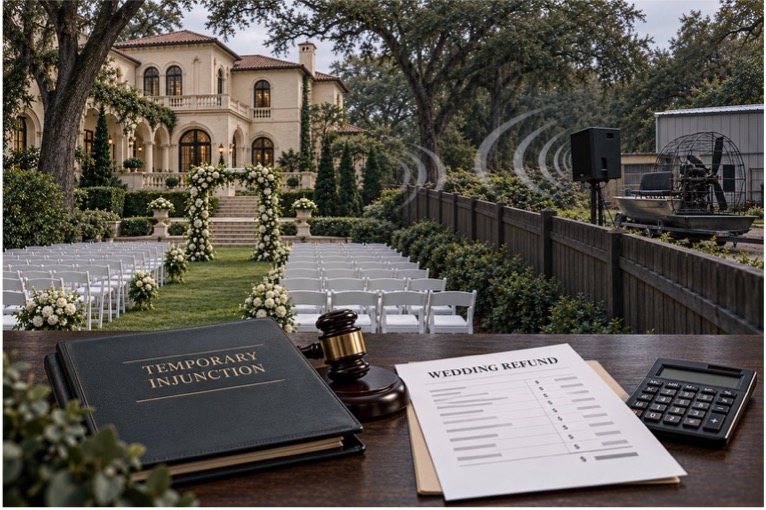
How far can a neighbor’s noise go in affecting a business? That question was put to the test in Hatcher v. Restorical, LLC. Restorical, the appellee in this case, owns the historic Sydonie Mansion in Mount Dora. For about nine years, Restorical has used the mansion to host weddings and other events, with a steady stream of bookings averaging two to three weddings per week during its busy season.[i] Brad and Audrey Hatcher own the neighboring property, where they keep dogs, boats, motor vehicles, and a shooting range.[ii] Restorical claimed the Hatchers had sporadically disrupted its weddings for years with loud music aimed at the mansion and dogs running onto the grounds. By 2025, Restorical alleged that the Hatchers were deliberately timing gunfire and revving chainsaw and airboat engines to coincide with wedding ceremonies.[iii]
Restorical sued the Hatchers for private nuisance and sought a temporary injunction.[iv] After an evidentiary hearing, the trial court found that Restorical was likely to succeed on its nuisance claim. It also found that the Hatchers’ conduct threatened Restorical’s goodwill and the viability of the venue, and that those injuries were irreparable and could not be compensated by money damages.[v] The trial court then barred the Hatchers from disrupting Restorical’s events while requiring Restorical to give the Hatchers twenty-four hours’ written notice of each event. This ruling led the Hatchers to appeal the trial court’s decision.
The central issue on appeal was whether Restorical proved it would suffer irreparable harm without the injunction. To obtain a temporary injunction in Florida, a party must prove a substantial likelihood of success on the merits, the unavailability of an adequate remedy at law, a likelihood of irreparable harm, and that the injunction serves the public interest.[vi] Failure to prove any one element requires denial, and an appellate court reviews the trial court’s findings on each element for competent, substantial evidence.[vii] The Sixth District addressed irreparable harm and inadequate remedy at law together, explaining that an injury is irreparable only when money damages cannot compensate it.[viii] The appellate court identified several ways a business can make that showing: where damages cannot be quantified, where the business faces destruction, or where the harm recurs so often that it would require a multiplicity of lawsuits.[ix] At the same time, the Sixth District noted that the loss of some business, without more, is not irreparable harm.[x]
Applying that framework, the Sixth District reversed. It acknowledged that competent, substantial evidence showed the Hatchers’ conduct was a harmful nuisance. It went further, noting that Amy Frogley, one of Restorical’s owners, testified she feared losing wedding business and the mansion itself. But fear is not proof. There was no evidence of cancellations or lost bookings, and nothing explaining why any lost business could not be calculated from Restorical’s nine-year track record.[xi] In fact, Restorical was still booking weddings without telling customers about the disruptions. One disruption did require a partial refund, but that refund was calculable, and nothing suggested refunds would recur.[xii] In other words, Restorical proved a nuisance, but not an injury that money could not fix. The Sixth District therefore reversed and remanded, noting that Restorical may still be able to prove irreparable harm on a better record.
For practitioners, Hatcher is a reminder that irreparable harm must be proven, not presumed. A business seeking a temporary injunction should come to the hearing with concrete evidence, such as cancellations, lost bookings, or testimony explaining why its losses cannot be measured.[xiii] Fear of future losses, however sincere, will not carry the burden. The lesson of Hatcher is simple: a party who wants a court to stop the noise must first prove that money cannot.
[i]See Hatcher v. Restorical, LLC, No. 6D2025-3091, 2026 WL 3268463, at *1–2 (Fla. Dist. Ct. App. 2026).
[ii]See id. at *2.
[iii]See id.
[iv]See id.
[v]See id.
[vi]See id. at *3; see also Fla. Dep’t of Health v. Florigrown, LLC, 317 So. 3d 1101, 1110 (Fla. 2021) (setting out the four elements a party must prove to obtain a temporary injunction).
[vii]See Florigrown, 317 So. 3d at 1110–11.
[viii]See Hatcher, 2026 WL 3268463, at *4–5.
[ix]See id. at *5–9; see also XIP Techs., LLC v. Ascend Glob. Servs., LLC, 253 So. 3d 1183, 1187 (Fla. Dist. Ct. App. 2018) (finding irreparable harm where “the unrefuted evidence below was that these actions by XIP would result in the total destruction of Ascend’s business”).
[x]See Hatcher, 2026 WL 3268463, at *7–8; see also State Dep’t of Transp. v. Kountry Kitchen of Key Largo, Inc., 645 So. 2d 1086, 1086 (Fla. Dist. Ct. App. 1994) (holding that “an alleged loss of business will not support a finding of irreparable injury”).
[xi]See Hatcher, 2026 WL 3268463, at *9–10.
[xii]See id. at *10–11.
[xiii]See id. at *9–11.