
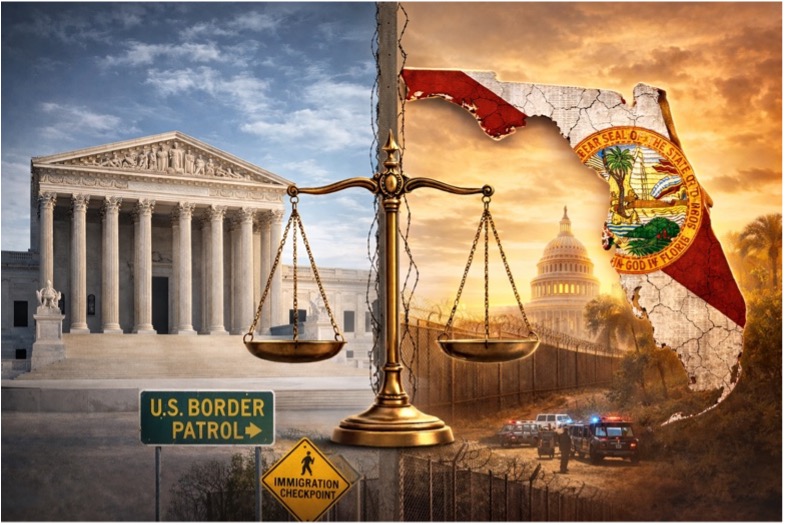
A recent Eleventh Circuit dispute addresses the ongoing tension between state immigration enforcement efforts and the federal government’s constitutional authority over immigration policy. The litigation centers on Florida’s Senate Bill 4-C (SB 4-C), a bill proposal enacted during a special legislative session that created new state crimes targeting certain undocumented immigrants who enter Florida after entering the United States without federal inspection or after prior removal.[i] Shortly after the law’s enactment, immigrant advocacy organizations and individual plaintiffs filed suit in the United States District Court for the Southern District of Florida against Attorney General James Uthmeier.[ii] More specifically, Florida Immigrant Coalition (FLIC) and the Farmworker Association of Florida (FWAF), along with two individuals, are the named plaintiffs in this case.[iii]
The central issue that the Eleventh Circuit will eventually decide is whether Florida’s statute intrudes upon a field that Congress has already occupied. The plaintiffs argued that SB 4-C violates the Supremacy Clause because immigration regulation falls primarily within the federal government’s authority.[iv] At the same time, Florida contends that states retain the authority to enact laws to deter unlawful entry into their territories. Plaintiffs argued that the Immigration and Nationality Act already governed as it regulated the entry, presence, and removal of noncitizens. This act leaves little room for states to create independent immigration crimes, meaning SB 4-C improperly creates a parallel state immigration offense that conflicts with the federal framework.
The Southern District Court of Florida agreed that the plaintiffs were likely to succeed on their constitutional claims and issued a preliminary injunction blocking enforcement of the statute while the case proceeds.[v] The court concluded that the law was likely preempted by federal immigration law because Congress had already created a detailed regulatory framework governing immigration enforcement.[vi] The district court also determined that the plaintiffs had standing to bring the lawsuit because they faced a credible threat of prosecution under the statute.
Florida appealed the injunction and asked the Eleventh Circuit to stay the district court’s order.[vii] A stay would allow the state to enforce the statute while the appellate court considers whether the district court correctly blocked the law. In reviewing the request, the Eleventh Circuit considered whether Florida demonstrated a likelihood of success on appeal and whether the balance of harms favored allowing the law to take effect. The Eleventh Circuit ultimately granted the state’s request for a stay of the injunction. As a result, the district court’s order preventing enforcement of SB 4-C has been temporarily suspended while the appeal moves forward. This procedural ruling allows Florida to enforce the statute during the pendency of the appeal, though the court has not yet resolved the underlying constitutional question concerning federal preemption.
While granting the order to stay, the Eleventh Circuit expedited the case to resolve the dispute more quickly. Although the Eleventh Circuit has not yet issued a final ruling on the Senate bill, the court’s stay order provides significant insight into its intentions. For now, the statute may be enforced while the appellate court evaluates the district court’s ruling.[viii] In July 2025, the United States Supreme Court ultimately denied Florida’s request to enforce its state immigration law.[ix] There was no dissenting opinion or explanation for the denial.[x] Their decision to deny the request follows a string of other decisions on laws similar to SB 4-C.[xi]
[i] See 2025 Fla. Sess. Law Serv. Ch. 2025-2 (S.B. 4-C) (West).
[ii] See Florida Immigrant Coalition, et. al v. James Uthmeier, et. al, 780 F. Supp. 3d 1235, 1251 (S.D. Fla. 2025).
[iii] See Federal Court Halts Florida’s Cruel Anti-Immigrant Law SB 4-C in Major Victory for Immigrant Justice, ACLU (Apr. 4, 2025, at 6:00 PM), https://www.aclu.org/press-releases/federal-court-halts-floridas-cruel-anti-immigrant-law-sb-4-c-in-major-victory-for-immigrant-justice (“The court ruled that the plaintiffs — including two individuals and two grassroots membership organizations, the Florida Immigrant Coalition (FLIC) and the Farmworker Association of Florida (FWAF) — are likely to succeed in showing that SB 4-C is unconstitutional.”).
[iv] See Florida Immigrant Coalition v. Uthmeier, ACLU (July 16, 2025), https://www.aclu.org/cases/florida-immigrant-coalition-v-uthmeier (“The court explained that ‘[i]t seems likely—given the federal government’s longstanding and distinct interest in’ immigration and Congress’s “extensive regulation” in this area—that SB 4C is preempted by federal law.”).
[v] See Federal Court Halts Florida’s Cruel Anti-Immigrant Law SB 4-C in Major Victory for Immigrant Justice, supra note iii.
[vi] See id.
[vii] See Florida Immigrant Coalition v. Uthmeier, supra note iv.
[viii] See id.
[ix] See U.S. Supreme Court Denies Florida’s Request to Enforce Unconstitutional Anti-Immigrant Law, ACLUFL (July 9, 2025, at 5:12 PM), https://www.aclufl.org/press-releases/u-s-supreme-court-denies-floridas-request-to-enforce-unconstitutional-anti-immigrant-law/.
[x] See id.
[xi] See id.