Breaking Chains on Bar Access: Florida Supreme Court Ends ABA Monopoly

Breaking Chains on Bar Access: Florida Supreme Court Ends ABA Monopoly

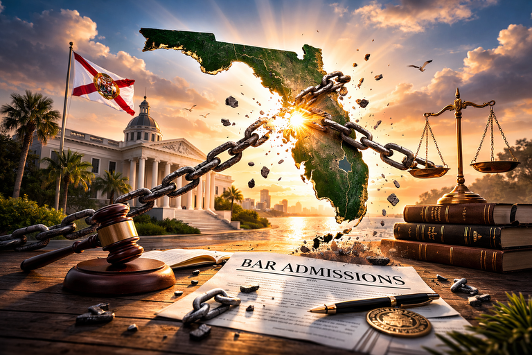
One credential quietly determined whether a law graduate could even attempt to become a Florida lawyer: graduate from a law school accredited by the American Bar Association (“ABA”). In April 1950, the Florida Supreme Court created the Florida Bar, uniting all licensed attorneys in the state into one organization, responsible for regulations.[i] The Florida Supreme Court’s order shifted the responsibility of disciplinary actions from local state attorneys to a Board of Governors consisting of fourteen special committees.[ii] In 1992, the ABA became the sole law school accreditor recognized in the Court, and the rules have relied on this accreditation since 1955.[iii] Due to the integration, rule 4-13.2 established that “an accredited law school is one approved or provisionally approved by the ABA at the time of, or within twelve months of, the applicant’s graduation.”[iv]

This requirement changed in January 2026, when the Florida Supreme Court amended its bar admission rules to end the ABA’s status as the sole accrediting gatekeeper.[v] The decision came after the Court appointed a workgroup to inquire on the issue in March 2025.[vi] Thus, based on that study, the Court decided it was not in Florida’s best interest for the ABA to continue to monopolize who is allowed to sit for the Bar Exam to earn their license to practice.[vii]

Under the amended rules, it “. . . promote[s] access to high-quality, affordable legal education in law schools that are committed to the free exchange of ideas and to the principle of nondiscrimination.”[viii] Florida continues to recognize graduates of ABA-accredited schools, but it also allows graduates of law schools accredited by other entities. The decision was possible because it was within the Court’s constitutional authority, “[t]he supreme court shall have exclusive jurisdiction to regulate the admission of persons to the practice of law and the discipline of persons admitted.”[ix] The decision raises an important question for the legal profession: whether expanding accreditation pathways will meaningfully improve access to legal education without sacrificing quality? This decision reflects a deliberate move away from a single national standard toward a more flexible regulatory framework.

The opinion emphasizes that this change is not a rejection of ABA-accreditation, rather, the Court frames its decision as a recalibration of authority. The new framework expands the definition of “accredited” to no longer exclusively correlate to the ABA.[x] The expanding on the amendment has two separate frameworks. First, it allows accreditation by any “programmatic accrediting agency recognized by the United States Department of Education to accredit programs in legal education that lead to the first professional degree in law.”[xi] Which is currently a category that only includes the ABA. Second, it permits accreditation by institutional accrediting agencies, provided those agencies are both federally recognized and approved by the Court.[xii] The latter option gives Florida the ability to impose its own conditions focused on outcomes, such as bar passage rates, employment disclosures, and curricular standards.[xiii]

For instance, the majority’s reasoning reflects concern about cost and access. Law school tuition is constantly increasing, and critics of the ABA accreditation process have long argued that compliance costs contribute to rising student debt. The United States Federal Trade Commission has called out the ABA for being a monopoly because it has increased the cost of earning a law degree, hindering the reservoir of new lawyers.[xiv] The ABA has historically been the only recognized law school accreditation in the nation, allowing for there to be only one distinct policy to adhere to.

However, Justice Labarga’s dissent highlights the risks inherent in departing from such a long-standing system.[xv] He emphasizes that the ABA has served as Florida’s sole accreditor since 1992 and has developed extensive expertise in evaluating legal education quality.[xvi] Justice Labarga also argues that the ABA standards provide consumer protection, transparency, and institutional accountability, features that may take years for any alternative accreditor to replicate.[xvii] The history behind the organization is a rather strong front, and this change will most likely not immediately pan out.

Nevertheless, the Court’s decision does not immediately transform Florida’s legal educational environment as the amendments take effect on October 1, 2026. Graduates of ABA-accredited schools remain fully eligible to sit for the Bar; the ruling creates a potential change rather than an immediate one, allowing for the proper development of the amendments. Whether this shift ultimately benefits aspiring lawyers and the public will depend on implementation. Texas and Florida stand as the catalysts for this movement, which can possibly lead to the erasure of the ABA’s monopoly on the law school atmosphere.

[i] Mark D. Killian & Samadhi Jones, The Florida Bar Timeline 1950–2025, Fla. Bar (Sep. 8, 2025), https://www.floridabar.org/the-florida-bar-news/the-florida-bar-timeline-1950-2025 (“In April 1950, the Florida Supreme Court entered an order officially creating The Florida Bar as an integrated (mandatory) bar, uniting all licensed attorneys in the state into a single professional organization responsible for regulating the practice of law.”).

[ii] Id.

[iii] See In Re Amends. to Rules Regulating Fla. Bar & Rules of Sup. Ct. Relating to Admissions to Bar, 51 Fla. L. Weekly 25 (2026).

[iv] Id.

[v] See id.; see also Liv Caputo, Florida Supreme Court Ends Three-Decade Reliance on ABA, Handing Win to DeSantis, Fla. Phoenix (Jan. 15, 2026, at 12:43 PM), https://floridaphoenix.com/2026/01/15/florida-supreme-court-ends-three-decade-reliance-on-aba-handing-win-to-desantis/.

[vi] See In Re Amends. to Rules Regulating Fla. Bar & Rules of Sup. Ct. Relating to Admissions to Bar, supra note iii.

[vii] See id.

[viii] Id.

[ix] Fla. Const. art. V, § 15.

[x] In Re Amends. to Rules Regulating Fla. Bar & Rules of Sup. Ct. Relating to Admissions to Bar, supra note iii.

[xi] Id.

[xii] Id.

[xiii] See id.

[xiv] See Chris Williams, FTC Blames High Law School Costs on ABA Accreditation, Above Law (Dec. 3, 2025, at 4:55 PM), https://abovethelaw.com/2025/12/ftc-blames-high-law-school-costs-on-aba-accreditation/.

[xv] See In Re Amends. to Rules Regulating Fla. Bar & Rules of Sup. Ct. Relating to Admissions to Bar, 51 Fla. L. Weekly 25 (2026) (Labarga, J., dissenting).

[xvi] See id.

[xvii] Id.
Home Court Advantage: The Potential Rise of State Court Favoritism in NCAA Eligibility Litigation

Home Court Advantage: The Potential Rise of State Court Favoritism in NCAA Eligibility Litigation

In the prominent world of Name, Image, and Likeness (“NIL”) in collegiate athletics, the National Collegiate Athletic Association (“NCAA”) has been involved in their fair share of litigation surrounding athletes requesting additional years of eligibility.  The most notable instance of the NCAA involved in litigation is against Trinidad Chambliss, the quarterback who led the University of Mississippi (“Ole Miss”) to their first College Football Playoff appearance in 2025-2026.[i]  Just a month ago, Chambliss was granted a favorable ruling by a trial court in Mississippi.[ii] But the NCAA is not only litigating claims against prominent athletes like Chambliss.

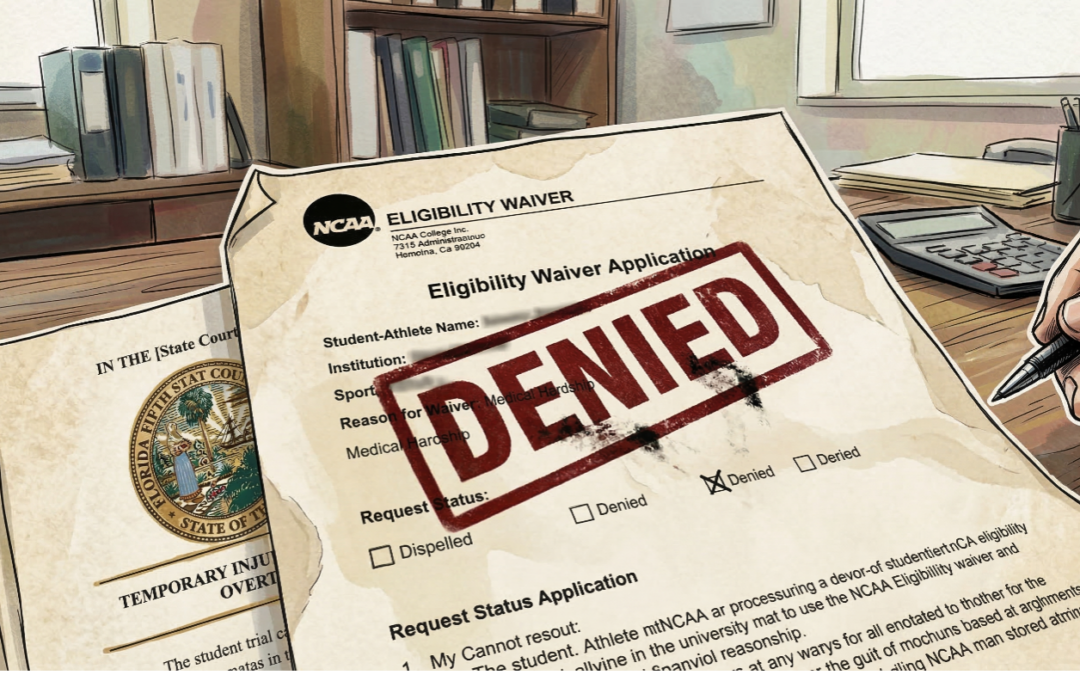
On March 6, 2026, Florida’s Fifth District Court of Appeal reversed the issuance of a preliminary injunction to Doctor Bradley (“Bradley”), a member of Bethune-Cookman University’s (“BCU”) basketball program.[iii]  BCU is the sixth university which Bradley has been enrolled in.[iv]  The most important information from these six years comes from Bradley’s penultimate college stop, as this is where the litigation against the NCAA stems from. While at Nicholls State University (“Nicholls State”) during the 2023-2024 season, Bradley opted to step away from the team amidst legal troubles he faced due to his involvement in a hazing incident at New Mexico State University (“NMSU”), the school he attended prior to Nicholls State.[v]  In a waiver filed to the NCAA by BCU on Bradley’s behalf, the school requested Bradley be granted an additional year of eligibility in part because he was denied an opportunity to play in the 2023-2024 season with Nicholls State due to circumstances beyond his own control.[vi] These circumstances were in reference to the hazing incident that Bradley was involved in.

The NCAA would deny the waiver request by finding there was no objective documentation that Bradley could not compete at Nicholls State for reasons that were beyond his control.[vii] The NCAA on reconsideration would further find that the 2023-2024 season was not a denied participation opportunity because Bradley decided himself to step away from the team, partially due to pending legal matters connected to the hazing incident.[viii] BCU would choose not to pursue any further appeals, and instead, Bradley would file a complaint against the NCAA.[ix] Bradley alleged that the NCAA was violating the Florida Antitrust Act by denying him a waiver to play with BCU, and sought to enjoin the NCAA from violating the Act.[x] Bradley also sought an order from the court declaring that he is entitled to play basketball for BCU for the 2025-2026 season.[xi]

The court below would grant Bradley’s temporary injunction on January 9, 2026, allowing him to join BCU for the remainder of the season.[xii] One of the main issues, according to the Fifth District, is that the lower court provided only a short two-paragraph analysis as to why Bradley was entitled to a temporary injunction.[xiii] The Fifth District noted the four elements necessary to establish a temporary injunction is warranted. They also provided Florida case law that states that a trial court must give clear, definite, and unequivocal sufficient factual findings to support each of the four elements.[xiv] The trial court’s two-paragraph analysis was obviously deficient to justify a temporary injunction, a remedy that is to be issued only in rare circumstances.[xv] The trail court’s order fell short due to its lack of sufficient factual findings for three of the temporary injunction elements while completely omitting to mention one of the elements entirely. Also mentioned was the fact that Bradley alleged a violation of the Florida Antitrust Act, a case that would be fact-intensive and surely garner more than two paragraphs of conclusory analysis.

This kind of favorable ruling for Bradley could spark an interesting conversation in that athletes may get more favorable rulings with local state court judges. For example, the previously mentioned Chambliss received a favorable ruling allowing him to play in a sixth year of college football after previously being denied additional eligibility. The judge who presides over Chambliss’ case, Judge Robert Whitwell, graduated from Ole Miss law,[xvi] and it could be argued that he subjectively might like to see Chambliss back with the Rebels because of his athletic abilities. In fact, Chambliss’ lawyers likely strategically filed in Mississippi state court.[xvii] There is no indication that the judge presiding over Bradley’s case, Judge Dennis Craig, is affiliated with BCU in any way. However, it could be argued that he would want to possibly see his local Division I college basketball team benefit from a veteran like Bradley playing. Issuing a conclusory and fact deficient order granted a precious remedy like a temporary injunction certainly can serve as circumstantial evidence that the filing in state courts is much more favorable to the college athletes and the NCAA would have to rely on the appellate court to correct orders such as the one entered in Bradley’s case.

[i] Pete Thamel, Ole Miss QB Trinidad Chambliss granted injunction for 2026, ESPN (Feb. 12, 2026 6:18 ET), https://www.espn.com/college-football/story/_/id/47912898/ole-miss-qb-trinidad-chambliss-granted-injunction-judge.

[ii] Id.

[iii] See Nat’l Collegiate Athletic Ass’n v. Bradley, No. 5D2026-0128, slip op. at 2 (Fla. 5th DCA Mar. 6, 2026).

[iv] Id.

[v] Id. (“Nicholls State University . . . where he transferred during the 2023-2024 season until Bradley left the team due to complications stemming from the hazing incident at NMSU”).

[vi] Id. at 3.

[vii] Id. at 4.

[viii] Id. at 4.

[ix] Bradley, slip op. at 4.

[x] Id.

[xi] Id.

[xii] Id.

[xiii] Id. at 4–5.

[xiv] See Fla. R. Civ. P. 1.610; see also Wayne’s Aggregate & Materials, LLC v. Lopez, 391 So. 3d 633, 636 (Fla. 5th DCA 2024).

[xv] See Bradley, slip op. at 6; see also Blue Earth Sols. V. Fla. Consol. Props., LLC, 113 So. 3d 991, 992 (Fla. 5th DCA 2013) (“A mandatory injunction should be issued in only the rarest of circumstances where the rights are clear and certain.”).

[xvi] Caleb Salers, Attorneys representing Ole Miss QB Chambliss sue NCAA for sixth year of eligibility, Super Talk Miss. Media (Jan. 16, 2026), https://www.supertalk.fm/attorneys-representing-ole-miss-qb-chambliss-sue-ncaa-for-sixth-year-of-eligibility/ (“The judge overseeing Chambliss’ case is Senatobia native Robert Whitwell, an Ole Miss Law graduate and former Northwest Mississippi Community College Quarterback.”).

[xvii] Thamel, supra note 1 (“The case was heard in a state court, which was a strategic decision by Chambliss’ lawyers when they filed for the injunction last month.”).

Florida Court Reaffirms Strict Gatekeeping Standard for Punitive Damages

Florida Court Reaffirms Strict Gatekeeping Standard for Punitive Damages

Motor vehicle negligence cases account for a large portion of personal injury litigation, yet punitive damages are rarely permitted unless there is sufficient supporting evidence.[i] Florida law imposes strict procedural and evidentiary requirements; under Florida Statutes section 768.72, a plaintiff may not plead punitive damages without demonstrating “clear and convincing evidence” that the defendant was engaged in “intentional misconduct or gross negligence.”[ii] Gross negligence is defined as conduct “so reckless or wanting in care that it constitute[s] a conscious disregard or indifference to the life, safety, or rights of persons exposed to such conduct.”[iii]

The Sixth District Court of Appeal recently applied these principles in Sagastume Mirlalda v. Mitchell, a decision that highlights the narrow circumstances in which punitive damages may be asserted in negligence cases.[iv] Here, the court addressed whether the trial court erred in granting the plaintiff leave to amend his complaint to assert punitive damages against both the driver and his employer companies. The appellate court ultimately reversed the trial court’s order, concluding that the plaintiff failed to establish a reasonable evidentiary basis for punitive damages under section 768.72.[v]

Sagastume worked for a concrete company that operated pump trailers on construction sites. While driving through a construction area, a pipe attached to his trailer became unsecured and struck another worker, Stafford Mitchell, causing injuries. Mitchell sued Sagastume and the company entities for negligence. In his motion for leave for punitive damages, Mitchell argued Sagastume’s conduct was grossly negligent because Sagastume had a history of driver’s license suspensions, was driving with an expired license at the time of the accident, and had allegedly been involved in a similar incident two days earlier. Mitchell also sought punitive damages against the employer entities based on negligent hiring, retention, and supervision.

The trial court granted the motion, concluding that Sagastume demonstrated willful and wanton conduct sufficient to support punitive damages. The court further determined that the employer could face both vicarious and direct punitive liability. The Sixth District disagreed, emphasizing that punitive damages are reserved for “truly culpable behavior” that would cause an average member of the community to exclaim, “Outrageous!”

First, the court rejected the plaintiff’s reliance on Sagastume’s prior driving history. Because these suspensions were unrelated to reckless driving or dangerous conduct, the court concluded that they were irrelevant to determining whether Sagastume acted with gross negligence on the day of the accident. Second, the court determined that Sagastume’s expired driver’s license did not support punitive damages. Although driving with an expired license may violate traffic laws, the court explained that such a violation does not establish gross negligence. Finally, the court found the accident two days earlier could not support punitive damages because the record contained no evidence explaining what caused that incident, and, therefore, could not establish that Sagastume acted recklessly in the accident at issue.

For these reasons, the appellate court also rejected the plaintiff’s theory of vicarious liability against the employer. Florida law requires proof an employee engaged in intentional misconduct or gross negligence before punitive damages may be imposed on the employer.[vii] The court also rejected direct liability against the employer. Because Sagastume had originally been hired as a mechanic and only later transferred to a driver position, the court concluded the plaintiff failed to present evidence showing that the managers acted with willful or malicious conduct when hiring and supervising Sagastume.

This decision reinforces Florida courts’ strict approach to punitive damages and clarifies that a defendant’s driving history is insufficient to support punitive damages unless it is directly connected to the conduct that caused the plaintiff’s injury. This case highlights the importance of demonstrating a clear nexus between the defendant’s prior conduct and the alleged misconduct at issue; administrative violations or unrelated driving infractions will rarely satisfy Florida’s demanding gross negligence standard. This decision also provides strong defense grounds to challenge punitive damages claims that rely on generalized character evidence rather than conduct that demonstrates a conscious disregard for public safety.

[i] See When Can You Seek Punitive Damages for an Auto Accident in Florida?, JD Supra (Nov. 17, 2025), https://www.jdsupra.com/legalnews/when-can-you-seek-punitive-damages-for-5002110/.

[ii] Fla. Stat. § 768.72 (1–2) (2024).

[iii] Fla. Stat. § 768.72 (2)(b) (2024).

[iv] Sagastume Mirlalda v. Mitchell, No. 6D2025-0451, 2026 WL 547765 (Fla. 6th DCA Feb. 27, 2026).

[v] Id.

[vi] Id.

[vii] Fla. Stat. § 768.72(3) (2024).

Authenticating AI Evidence in Florida: Closing the Gaps

Authentication is the foundation of admissibility. Under § 90.901, evidence must be authenticated or identified before it can be admitted, a requirement satisfied by showing enough proof that the evidence is what the proponent claims it to be.[i] In Florida, this threshold is relatively low. Courts allow authentication through a variety of means, including appearance, content, substance, internal patterns, or other distinctive characteristics, either supported by extrinsic proof or through self-authentication. However, the rise of artificial intelligence (“AI”) poses new challenges to this framework. AI-generated content can appear highly convincing while bearing no connection to reality. Without stronger safeguards, courts risk admitting unreliable AI-based evidence that slips through under the current low bar.

Florida courts are finding ways to deal with digital evidence by adapting old rules to new technology, but they also make sure not to weaken important protections like authentication, privacy, and fairness in the process. Florida’s Evidence Code § 90.901 requires that evidence be supported by proof sufficient to show that it is what its proponent claims, and courts have applied this requirement with notable flexibility. In Lamb v. State, the Fourth DCA upheld the admission of a Facebook Live video authenticated through forensic testimony, reflecting the judiciary’s willingness to admit digital content when properly connected to its source.[ii] Similarly, in Tracey v. State, the Florida Supreme Court required warrants for cell-site location data, adapting constitutional protections to the realities of digital surveillance.[iii]Additionally, in Wilsonart, LLC v. Lopez, while the Court declined to create a narrow exception for video evidence, it signaled its intent to adopt the federal Celotex summary judgment standard.[iv] An intent later formalized in the amendment of Rule 1.510, reshaped Florida’s summary judgment practice giving judges greater authority to grant judgment when one side has no real evidence.[v] Taken together, these decisions illustrate how Florida courts balance adaptability with restraint, extending established doctrines to address digital evidence without undermining the foundational protections of authentication, privacy, and procedural fairness.

Even with safeguards, authentication is vulnerable. Parties are not required to disclose whether evidence is AI generated and contextual markers like metadata can be fabricated. Proprietary algorithms may avoid Daubert review if methods are withheld (e.g., facial recognition software). Unlike federal courts, Florida lacks self-authentication rules for electronic records, forcing reliance on live testimony for even routine digital files.[vi]

The judiciary has already flagged AI concerns. In 2023, the Office of the State Courts Administrator warned that deepfakes and synthetic media could strain authentication standards. Florida’s 2025 procedural reforms, such as proportional discovery[vii], revised summary-judgment timelines[viii], and the Supreme Court’s ongoing review of Evidence Code amendments (SC2025-0659) create an opening to confront AI’s impact directly.[ix]

Florida can act before AI evidence overwhelms its courts. While Florida Statute § 90.901, Daubert, and contextual proof offer a baseline, stricter disclosure and reliability rules in the pending Evidence Code amendments are needed to keep synthetic evidence out of the record.

[i] Fla. Stat. § 90.901 (2025).

[ii] Lamb v. State, 246 So. 3d 400, 413 (Fla. 4th DCA 2018).

[iii] Tracey v. State, 152 So. 3d 504 (Fla. 2014).

[iv] Wilsonart, LLC v. Lopez, 308 So. 3d 961 (Fla. 2020); Celotex Corp. v. Catrett, 477 U.S. 317 (1986).

[v] See Fla. R. Civ. P. 1.510 (2025).

[vi] See Fed. R. Evid. 902(13)–(14); see also Daubert v. Merrell Dow Pharm., Inc., 509 U.S. 579, 113 S. Ct. 2786 (1993) (allowing judges act as evidentiary gatekeepers grounded in scientifically valid methodology as demonstrated through factors like testability, peer review, error rates, standards, and general acceptance).

[vii] Fla. R. Civ. P. 1.280 (2025)

[viii] Fla. R. Civ. P. 1.510 (2025)

[ix] In re Amends. to the Fla. Evidence Code § 90.404(2)(c), No. SC2025-0659 (proposed Apr. 2025).

Prospective Plaintiff Denied Pursuant to Florida Pre-Suit Requirements Under Chapter 766 in Recent District Court of Appeals Decision

Prospective Plaintiff Denied Pursuant to Florida Pre-Suit Requirements Under Chapter 766 in Recent District Court of Appeals Decision

One detail missed, several lives affected. Despite the harm that can result from medical misconduct, it is not as easy for prospective plaintiffs to file a medical negligence claim. First, a claimant must complete an adequate pre-suit investigation prior to filing the complaint in Court. The statutory safeguard confirms the prospective plaintiff’s claim is supported by reasonable grounds. The required investigation includes: (1) a notice of intent to initiate litigation; and (2) a corroborating affidavit written by a medical expert in a similar field as the defendant health care provider.

 In a recent case, the Fourth District Court of Appeals opined that a proper corroborating affidavit is a “low bar.”[i]As such, the penalties for failing to conduct an adequate pre-suit investigation have severe consequences commanded by the statute. The court shall dismiss the claim if the notice of intent to initiate litigation is inadequate.[ii]  Additionally, the person who mailed such notice, either the claimant or the claimant’s attorney, would be personally liable for all attorneys’ fees and costs incurred during the investigation and evaluation of the claim.  A motion to dismiss would raise the issue of whether the corroborating affidavit is sufficient for a legitimate claim of medical negligence.[iii]

In Potapric v. Barnes, the Court dismissed a medical negligence claim for failing to comply with the statutory pre-suit requirements.[iv] Following alleged post-surgical complications, Barnes sued Dr. Potparic for medical negligence. Barnes’ expert affidavit stated Potparic violated the medical standard of care by performing the surgery while not properly registered with the Florida Department of Health. The affidavit mentioned a breach also where the nurse administered anesthesia while the supervising doctor was not properly registered. Discovery later revealed that Potparic was properly registered at the time of the surgery, and Barnes sought leave to file a second amended complaint. Barnes now alleged she was harmed because the nurse who administered the anesthesia was not properly registered with the Department of Health. However, Barnes did not submit a new affidavit with the second amended complaint. The affidavit did not mention the nurse’s own registration or describe any deficient act or how such act caused Barnes to have any injury.

The court looked at whether the notice of intent to initiate litigation and the corroborating expert opinion, taken together sufficiently indicated that Dr. Potparic allegedly deviated from the standard of care, and if Barnes provided adequate information for the defendants to evaluate the merits of the claim.[v] The Court agreed with Potparic that the affidavit does not corroborate reasonable grounds to support the claim of medical negligence set out in the second amended complaint. The only theory of negligence described in the claimant’s expert’s affidavit proved unfounded and was abandoned. The affidavit lent no support to the claim alleged in Barnes’s second amended complaint. Because Barnes failed to comply with the procedural requirements, the Court quashed the order denying dismissal with directions to grant the dismissal as commanded by statute. Along with dismissal, either Barnes or her attorney will be personally liable for the attorney’s fees and costs associated with investigating this claim.[vi]

While the District Court opinion did not reach the issue of consequences for failing to conduct a reasonable investigation, the statute commands liability for attorney’s fees and costs and disciplinary review with the Florida Bar.[vii]

[i] Potparic v. Barnes, No. 4D2025-1701, 2025 Fla. App. LEXIS 7301, at *6 (Fla. Dist. Ct. App. Sep. 24, 2025).

[ii] Fla. Stat. § 766.206(2) (2025).

[iii] Id.

[iv] Potparic v. Barnes, No. 4D2025-1701, 2025 Fla. App. LEXIS 7301, at *6 (Fla. Dist. Ct. App. Sep. 24, 2025).

[v] Id. at *5.

[vi] See Fla. Stat. §766.206(2)(2025).

[vii] Fla. Stat. § 766.206 (4).

Upon Deaf Ears: Understanding 3M’s Invocation of the Government-Contractor Defense

Upon Deaf Ears: Understanding 3M’s Invocation of the Government-Contractor Defense

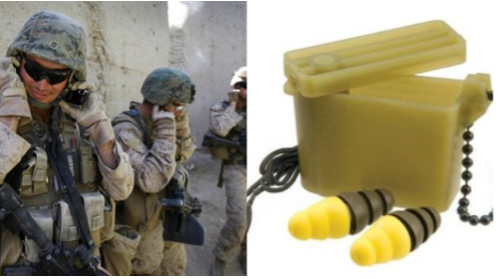
3M corporation, long a staple of American industry, has recently been rocked by a string of lawsuits related to defective earplugs it sold to the U.S. military in what has been termed the largest multi-district litigation in U.S. history.1 As of the writing of this article, plaintiffs (all former U.S. military veterans have been awarded a staggering combined amount of $160 million in six bellwether trials.2 The entire controversy stems from 3M’s 2008 acquisition of Aearo Technologies, the company which manufactured the earplugs.3 The reason Aearo’s design of earplugs appealed to the U.S. military resulted from its innovative design: the dual-ended design allowed one end to block out as much sound as possible while the other end protected a user’s ears from extremely loud noises such as gunfire or explosions.4 This design was advantageous because it allowed troops to communicate with fellow soldiers nearby during loud situations.5

In a recent filing, 3M sought to appeal its first trial loss in the massive multi-district litigation. In its appeal before the Eleventh Circuit, the company’s lawyers sought to invoke a legal doctrine known as the government-contractor defense.6 Essentially, the company argued that this federal doctrine preempted the plaintiff’s state law claims of product defect and failure to warn.7 The defense has its roots in the concept of sovereign immunity.8 The essential elements for this defense were resolved in the case of Boyle v. United Technologies Corp. pursuant to a split among the circuits.9 Based upon the rule articulated in Boyle, 3M would have to prove the following elements in order to avoid liability: (1) the United States approved reasonably precise specifications [of the product’s design]; (2) the equipment conformed to those specifications; and (3) the supplier (3M) warned the United States about the dangers in the use of the equipment that were known to the supplier but not to the United States. 10 Invocation of this defense may signal a strategic shift in how 3M handles the flurry of litigation that has arisen from this tragic issue. Either way, this recent filing could set the stage for the mountain of other cases the embattled conglomerate is confronted with.

1 Brooke Sutherland, 3M Adds Another Legal Worry to Its Pile of Headaches, BLOOMBERG, Feb. 14, 2022, https://www.bloomberg.com/opinion/articles/2022-02-14/3m-adds-an-earplug-legal-worry-to-its-pile-of-headaches. 2 Nate Raymond, 3M on appeal says first trial in massive earplug litigation went ‘off the rails,’ REUTERS, Feb. 25, 2022, https://www.reuters.com/legal/litigation/3m-appeal-says-first-trial-massive-earplug-litigation-went-off-rails- 2022-02-25/.
3 Supra note 1.
4 Id.
5 Id.
6 Id.
7 Id.
8 Steven Brian Loy, NOTE: The Government Contractor Defense: Is It a Weapon Only for the Military?, 83 Ky. L.J. 505, 506.
9 Id.
10 Id.