
One Dragon, One Emperor, and One Professor Walk into a Hospital

One Dragon, One Emperor, and One Professor Walk into a Hospital

In Brown v. Fla. Health Sci. Ctr., Inc., the Second District Court of Appeals held that the trial court erred by not recognizing there were factual disputes that precluded summary judgment.[i] The trial court granted summary judgment to the respondent, Tampa General Hospital (TGH), because it found that petitioner Valerie Brown was a trespasser and therefore was not owed a duty of care by the hospital. [ii]

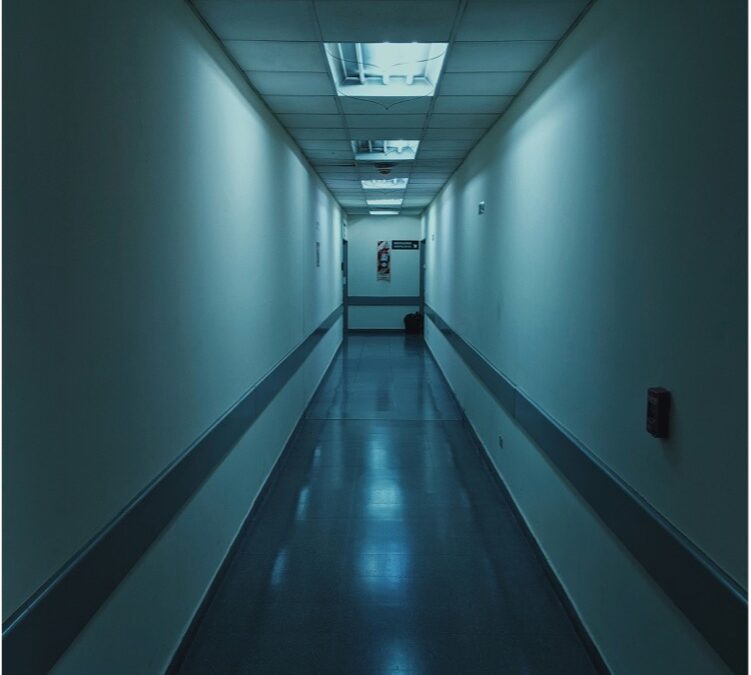
As Ms. Brown was bending over her father’s hospital bed, saying goodbye, all she remembers is being hit by the psychiatric patient who was sharing a room with her father.[iii] Ms. Brown was visiting her father, who was recovering from spinal surgery at TGH. The hospital placed a psychiatric patient, exhibiting hallucinations, agitation, erratic behavior, and noncompliance, in the same room as Ms. Brown’s father.[iv] The psychiatric patient repeatedly left his bed, ripped out his IV, and told staff that he was an emperor while jumping up and down on the bed.[v]  The psychiatric patient also screamed for Ms. Brown and her father to look at a dragon outside.[vi] He then ran out of the room and through the hallway, screaming, “fire!”[vii] The hospital staff also caught him wandering the halls, saying that he was looking for the “professor.”[viii] During this time, Ms. Brown’s father was bed-bound because of his spinal surgery, which caused Ms. Brown to be in fear for her father’s safety. She repeatedly expressed concerns to nurses, who refused to move either patient.[ix]

It is surprising that the trial court agreed with TGH that Ms. Brown was a trespasser, given that visitors are almost as vital to a hospital as its patients. When visiting someone in the hospital, the visitor is usually there because something medically serious has occurred. In the middle of the night, the visitor is there to offer support, love, prayer, and perhaps to crack a joke in an otherwise solemn setting. The visitor may have never been to a hospital before and could be scared by what they see: people being rolled around on beds, connected to tubes, rushing doctors, and crash carts whizzing by. Altogether, not a place that people choose to go on their day off. That being the case, a visitor is owed a standard duty of care as an invitee, not a trespasser. Visitors come bearing flowers, fruit baskets, balloons, get-well cards, and platters of food. If visitors were labeled as trespassers, it could negatively affect some very impactful people.

The trial court agreed with TGH’s position that because it was after visiting hours, Ms. Brown was a trespasser[x]. An invitee may become a trespasser “after the expiration of a reasonable time within which to accomplish the purpose for which [s]he is invited to enter, or to remain.”[xi] Ms. Brown’s status as a trespasser or invitee is bound up with material factual issues appropriate for jury resolution.[xii] Assuming that Ms. Brown was an invitee, we note that a property owner owes an invitee “the duty ‘to use reasonable care in maintaining property in a reasonably safe condition.’”[xiii] It’s clear that in this case, not only did the hospital have notice of the increasingly erratic behavior, but they acted with apathy towards Ms. Brown’s concerns. As a visitor, the hospital owed her a duty to ensure the conditions in which her father was being cared for were adequate.

The Second District Court of Appeals rightfully reversed the summary judgment and remanded the matter to the finder of fact. Whether Ms. Brown was a trespasser and whether the hospital owed her a duty of care are unresolved factual issues that preclude summary judgment for TGH and are better left to the jury.

[i] Brown v. Fla. Health Sci. Ctr., Inc., 51 Fla. L. Weekly 203 (Dist. Ct. App. 2026).

[ii] Id. at 12.

[iii] Id. at 4.

[iv] Id. at 1.

[v] Id. at 2.

[vi] Id. at 3.

[vii] Id.

[viii] Id. at 2.

[ix] Id.

[x] Id. at 6.

[xi] Byers v. Radiant Grp., L.L.C., 966 So. 2d 506, 509 (Fla. Dist. Ct. App. 2007) (quoting Restatement (Second) of Torts, § 61 at 425).

[xii] Brown v. Fla. Health Sci. Ctr., Inc., 51 Fla. L. Weekly 203, 9 (Dist. Ct. App. 2026).

[xiii] Ruiz v. Wendy’s Trucking, LLC, 357 So. 3d 292, 301 (Fla. 2d DCA 2023).
Breaking Chains on Bar Access: Florida Supreme Court Ends ABA Monopoly

Breaking Chains on Bar Access: Florida Supreme Court Ends ABA Monopoly

One credential quietly determined whether a law graduate could even attempt to become a Florida lawyer: graduate from a law school accredited by the American Bar Association (“ABA”). In April 1950, the Florida Supreme Court created the Florida Bar, uniting all licensed attorneys in the state into one organization, responsible for regulations.[i] The Florida Supreme Court’s order shifted the responsibility of disciplinary actions from local state attorneys to a Board of Governors consisting of fourteen special committees.[ii] In 1992, the ABA became the sole law school accreditor recognized in the Court, and the rules have relied on this accreditation since 1955.[iii] Due to the integration, rule 4-13.2 established that “an accredited law school is one approved or provisionally approved by the ABA at the time of, or within twelve months of, the applicant’s graduation.”[iv]

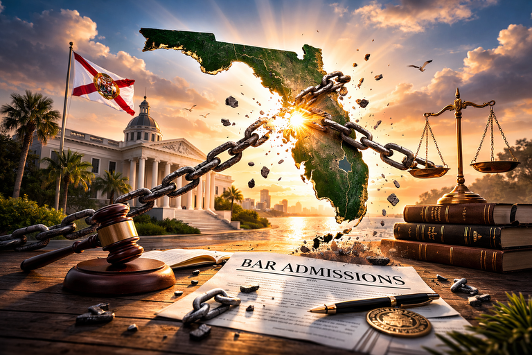
This requirement changed in January 2026, when the Florida Supreme Court amended its bar admission rules to end the ABA’s status as the sole accrediting gatekeeper.[v] The decision came after the Court appointed a workgroup to inquire on the issue in March 2025.[vi] Thus, based on that study, the Court decided it was not in Florida’s best interest for the ABA to continue to monopolize who is allowed to sit for the Bar Exam to earn their license to practice.[vii]

Under the amended rules, it “. . . promote[s] access to high-quality, affordable legal education in law schools that are committed to the free exchange of ideas and to the principle of nondiscrimination.”[viii] Florida continues to recognize graduates of ABA-accredited schools, but it also allows graduates of law schools accredited by other entities. The decision was possible because it was within the Court’s constitutional authority, “[t]he supreme court shall have exclusive jurisdiction to regulate the admission of persons to the practice of law and the discipline of persons admitted.”[ix] The decision raises an important question for the legal profession: whether expanding accreditation pathways will meaningfully improve access to legal education without sacrificing quality? This decision reflects a deliberate move away from a single national standard toward a more flexible regulatory framework.

The opinion emphasizes that this change is not a rejection of ABA-accreditation, rather, the Court frames its decision as a recalibration of authority. The new framework expands the definition of “accredited” to no longer exclusively correlate to the ABA.[x] The expanding on the amendment has two separate frameworks. First, it allows accreditation by any “programmatic accrediting agency recognized by the United States Department of Education to accredit programs in legal education that lead to the first professional degree in law.”[xi] Which is currently a category that only includes the ABA. Second, it permits accreditation by institutional accrediting agencies, provided those agencies are both federally recognized and approved by the Court.[xii] The latter option gives Florida the ability to impose its own conditions focused on outcomes, such as bar passage rates, employment disclosures, and curricular standards.[xiii]

For instance, the majority’s reasoning reflects concern about cost and access. Law school tuition is constantly increasing, and critics of the ABA accreditation process have long argued that compliance costs contribute to rising student debt. The United States Federal Trade Commission has called out the ABA for being a monopoly because it has increased the cost of earning a law degree, hindering the reservoir of new lawyers.[xiv] The ABA has historically been the only recognized law school accreditation in the nation, allowing for there to be only one distinct policy to adhere to.

However, Justice Labarga’s dissent highlights the risks inherent in departing from such a long-standing system.[xv] He emphasizes that the ABA has served as Florida’s sole accreditor since 1992 and has developed extensive expertise in evaluating legal education quality.[xvi] Justice Labarga also argues that the ABA standards provide consumer protection, transparency, and institutional accountability, features that may take years for any alternative accreditor to replicate.[xvii] The history behind the organization is a rather strong front, and this change will most likely not immediately pan out.

Nevertheless, the Court’s decision does not immediately transform Florida’s legal educational environment as the amendments take effect on October 1, 2026. Graduates of ABA-accredited schools remain fully eligible to sit for the Bar; the ruling creates a potential change rather than an immediate one, allowing for the proper development of the amendments. Whether this shift ultimately benefits aspiring lawyers and the public will depend on implementation. Texas and Florida stand as the catalysts for this movement, which can possibly lead to the erasure of the ABA’s monopoly on the law school atmosphere.

[i] Mark D. Killian & Samadhi Jones, The Florida Bar Timeline 1950–2025, Fla. Bar (Sep. 8, 2025), https://www.floridabar.org/the-florida-bar-news/the-florida-bar-timeline-1950-2025 (“In April 1950, the Florida Supreme Court entered an order officially creating The Florida Bar as an integrated (mandatory) bar, uniting all licensed attorneys in the state into a single professional organization responsible for regulating the practice of law.”).

[ii] Id.

[iii] See In Re Amends. to Rules Regulating Fla. Bar & Rules of Sup. Ct. Relating to Admissions to Bar, 51 Fla. L. Weekly 25 (2026).

[iv] Id.

[v] See id.; see also Liv Caputo, Florida Supreme Court Ends Three-Decade Reliance on ABA, Handing Win to DeSantis, Fla. Phoenix (Jan. 15, 2026, at 12:43 PM), https://floridaphoenix.com/2026/01/15/florida-supreme-court-ends-three-decade-reliance-on-aba-handing-win-to-desantis/.

[vi] See In Re Amends. to Rules Regulating Fla. Bar & Rules of Sup. Ct. Relating to Admissions to Bar, supra note iii.

[vii] See id.

[viii] Id.

[ix] Fla. Const. art. V, § 15.

[x] In Re Amends. to Rules Regulating Fla. Bar & Rules of Sup. Ct. Relating to Admissions to Bar, supra note iii.

[xi] Id.

[xii] Id.

[xiii] See id.

[xiv] See Chris Williams, FTC Blames High Law School Costs on ABA Accreditation, Above Law (Dec. 3, 2025, at 4:55 PM), https://abovethelaw.com/2025/12/ftc-blames-high-law-school-costs-on-aba-accreditation/.

[xv] See In Re Amends. to Rules Regulating Fla. Bar & Rules of Sup. Ct. Relating to Admissions to Bar, 51 Fla. L. Weekly 25 (2026) (Labarga, J., dissenting).

[xvi] See id.

[xvii] Id.